
Before the Declaration, There Was Care: Pamalihi Higaunon Declare 4,808.5 Hectares as Indigenous Conserved Territories and Reaffirm Ancestral Stewardship

Updated: 19 hours ago
Marking the 29th anniversary of the Indigenous Peoples' Rights Act, the Higaunon community of Pamalihi in Misamis Oriental declares three Indigenous conserved territories, reaffirming the ties between ancestral rights, customary governance, living culture, and biodiversity conservation.
A Declaration Rooted in Generations of Care
Long before conservation areas were formally declared, the Higaunon community of Pamalihi had its own ways of caring for the forests, waters, and living territories of its ancestral domain.
On October 23, 2026, Indigenous leaders and community members gathered in Misamis Oriental to mark a new milestone in that continuing responsibility: the declaration of Pina, Batal-batal, and Bahaw-bahaw as Indigenous Peoples' and Community Conserved Territories and Areas (ICCAs), spanning a combined 4,808.5 hectares.
Held ahead of the 29th anniversary of Republic Act No. 8371, or the Indigenous Peoples' Rights Act (IPRA) of 1997, the declaration brings into focus a fundamental principle of Indigenous rights and conservation: ancestral territories are not only places to be protected, but living landscapes governed through community knowledge, customary laws, and responsibilities passed across generations. The gathering brought together Pamalihi Higaunon leaders and community members, alongside representatives of partner organizations and government agencies, to witness and affirm the community's conservation commitment.

More Than Forests: A Living Ancestral Landscape
For the Higaunon community of Pamalihi, ancestral forests are more than natural resources. They are places where livelihoods, cultural identity, traditional knowledge, and spiritual relationships with the natural world remain deeply connected.
These relationships have long informed how communities understand their responsibilities to the land and the life it sustains. Among the cultural values highlighted in Pamalihi's account is Bungkatol ha Bulawan daw Nangka Tasa Halana, which emphasizes unity, peace, justice, and equality. Such values form part of the cultural foundations through which the community understands collective life, responsibility, and governance.
This relationship between culture and conservation is important. Forests sustain more than biodiversity and ecosystem services: they are also connected to the knowledge, practices, and ways of life that Indigenous communities transmit across generations. Safeguarding ancestral territories, therefore, also means safeguarding the cultural knowledge and governance systems through which communities maintain their relationships with those territories.

Three Territories, One Community Conservation Commitment
The Pamalihi ancestral domain extends across approximately 14,872 hectares within the municipalities of Balingasag and Claveria in Misamis Oriental, encompassing forests, agricultural lands, rivers, wildlife habitats, and culturally significant sites.

Through the October 23 declaration, the Higaunon community identified three territories as ICCAs:
Pina — 516.67 hectares
Batal-batal — 407.39 hectares
Bahaw-bahaw — 3,884.44 hectares
Together, these territories cover 4,808.5 hectares, representing approximately 32% of the Pamalihi ancestral domain. The forests within these ancestral landscapes support diverse plants and wildlife and contribute to watershed protection, carbon storage, and other essential ecological functions. Yet the significance of the declaration goes beyond the size of the areas identified.
An ICCA is grounded in the enduring relationship between a community and its territory, the community's governance and knowledge systems, and the conservation of natural and cultural values through those systems. By declaring Pina, Batal-batal, and Bahaw-bahaw as ICCAs, the Pamalihi Higaunon reaffirm their collective commitment to govern and care for territories that sustain both ecological and cultural life.
The October 23 milestone is a community-led declaration. It does not, by itself, constitute a new government-declared Protected Area or confirm registration under a national or international ICCA registry.

Indigenous Rights Recognized, Responsibilities Sustained
The declaration holds particular significance as the Philippines commemorates 29 years of the Indigenous Peoples' Rights Act. Enacted on October 29, 1997, IPRA recognizes and protects Indigenous Peoples' rights to ancestral domains, self-governance, cultural integrity, and the sustainable use and management of natural resources. Importantly, the law recognizes ancestral domains as encompassing more than their physical boundaries. They include the cultural and spiritual relationships through which Indigenous Peoples understand and maintain their connection to their territories.
IPRA also recognizes the Indigenous concept of ownership, in which ancestral domains and their resources are understood as community property belonging across generations. For Pamalihi, these rights have an established history of formal recognition. The community received its Certificate of Ancestral Domain Title (CADT) on April 6, 2006. Two decades later, the declaration of Pina, Batal-batal, and Bahaw-bahaw marks another community-led step in exercising responsibility for the governance and protection of its ancestral territory.
The milestone also illustrates an important distinction: recognizing Indigenous Peoples as rights-holders means recognizing their authority to make decisions concerning their territories, according to their own knowledge, institutions, and customary governance systems. For conservation to be genuinely rights-based, such authority must be respected and strengthened, rather than displaced by external conservation arrangements.

Indigenous Stewardship and Biodiversity Conservation in Practice
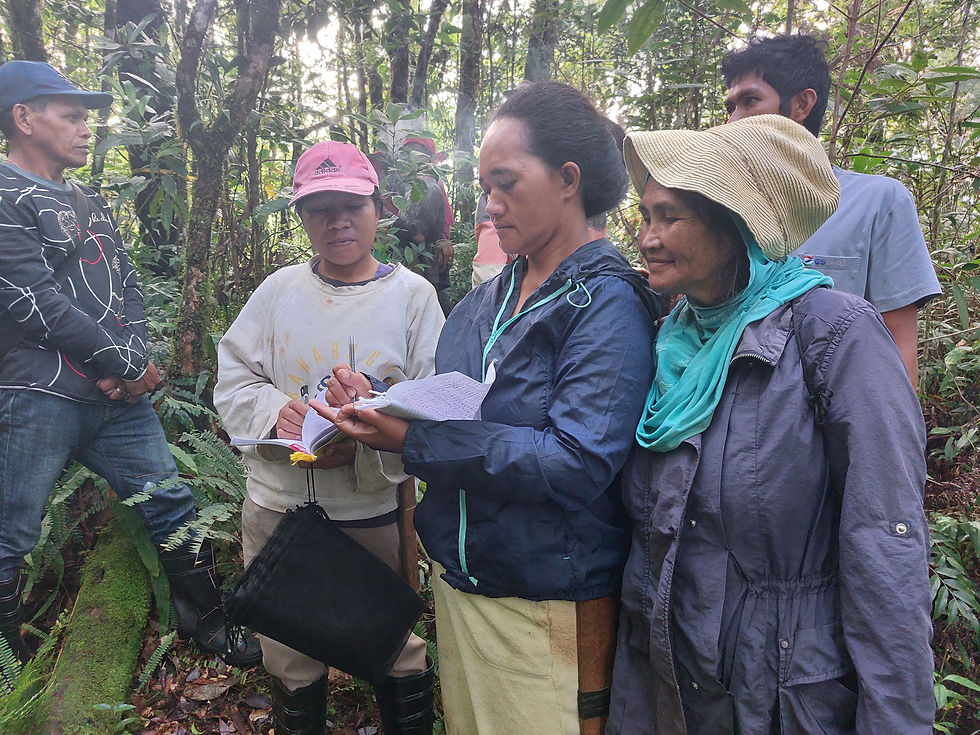
Pamalihi's conservation commitment is connected to continuing efforts to understand, document, and safeguard the biodiversity of its ancestral forests. Community-based biodiversity and carbon stock assessments conducted in the Pamalihi landscape have involved Indigenous community members in documenting forest conditions, plant diversity, and carbon stocks.
These efforts have also provided opportunities to strengthen local capacities in ecological monitoring and documentation, bringing community knowledge and technical assessment methods into conversation. Higaunon women have participated in biodiversity and carbon stock assessment activities within the ancestral domain, reflecting the importance of community participation in the work of understanding and protecting forest ecosystems.
Such efforts help demonstrate that Indigenous-led conservation is not limited to the formal identification of conserved areas. It also involves sustained knowledge, monitoring, decision-making, and responsibility for ecological conditions over time. Traditional knowledge and community-based documentation can strengthen one another, particularly when Indigenous Peoples retain a meaningful role in defining conservation priorities and determining how information about their territories is used.
From Ancestral Territories to Global Biodiversity Commitments
Beyond its local significance, Pamalihi's declaration also reflects principles advanced through the Kunming–Montreal Global Biodiversity Framework, the international agreement adopted under the Convention on Biological Diversity to guide global biodiversity action toward 2030.
Target 3 calls for the effective conservation and management of at least 30% of the world's terrestrial and inland water areas, and of coastal and marine areas, by 2030. Importantly, it recognizes Indigenous and traditional territories, where applicable, and emphasizes equitable governance and respect for the rights of Indigenous Peoples and local communities.
Target 22 calls for the full, equitable, inclusive, and effective participation of Indigenous Peoples and local communities in biodiversity-related decision-making, with respect for their cultures, territories, resources, and traditional knowledge.
Pamalihi's declaration illustrates how these principles can find expression in community-led action: through Indigenous decision-making, the identification of territories for conservation, and the continued practice of customary governance and ecological stewardship. The community has also been involved in efforts to localize the Indigenous Peoples Biodiversity Strategy and Action Plan (IPBSAP), connecting broader biodiversity priorities with Indigenous knowledge, customary practices, and community-defined conservation aspirations.
These initiatives reinforce a fundamental lesson for biodiversity conservation: global commitments become more meaningful when they recognize and support the peoples who govern and care for territories on the ground. The community declaration is an important expression of Indigenous conservation leadership. Any subsequent formal registration, recognition, or inclusion in national or global conservation reporting would involve separate processes, including appropriate community consent and safeguards.
A Living Responsibility for Future Generations
The October 23 declaration marks an important milestone, but the work of sustaining Pina, Batal-batal, and Bahaw-bahaw continues beyond the signing of a document. Long-term protection will depend on the strength of community governance, meaningful participation of elders, women, and youth, and the continued transmission of Indigenous knowledge and customary practices. It will also depend on the recognition and support that enable Indigenous communities to exercise their rights and responsibilities over their ancestral territories.

As the Philippines marks the 29th anniversary of IPRA, Pamalihi offers a concrete reminder of why Indigenous rights and biodiversity conservation must be advanced together. The declaration of 4,808.5 hectares is significant. But behind that figure is a longer history of cultural knowledge, collective responsibility, and relationships with forests that extend across generations.
Recognizing such stewardship means recognizing Indigenous Peoples not simply as participants in conservation, but as rights-holders, knowledge holders, and decision-makers whose authority and cultural continuity are essential to sustaining their territories.
The land was protected long before it was declared. Its future depends on continuing to respect the peoples and relationships through which that care endures.
Learn more: Explore NTFP-EP Philippines' ICCA Hub to understand Indigenous Peoples' and Community Conserved Territories and Areas, their relationship to customary governance, and ongoing efforts to strengthen ICCA recognition in the Philippines.
About NTFP-EP Philippines: NTFP-EP Philippines works with Indigenous Peoples and local communities to strengthen sustainable forest-based livelihoods, Indigenous rights and governance, cultural continuity, and community-led conservation.


Comments